Retrospective: Liturgy is Theology
Here’s a blog post I wrote back in 2013, during my time as a Lutheran. I thought it would be interesting to reflect on where I was back then in my faith journey, and to analyze how my faith has evolved since. I'll explore both how my beliefs at the time contributed positively to my journey toward the Catholic Church, as well as what aspects I’ve since renounced as either incomplete or mistaken.
Liturgy is Theology
22nd October 2013, Ben Copeland
This blog that you are reading now exists because I am, to some extent, a theologian. Mainly, I am a theologian for my household, my wife and daughter. These two people, and anyone we add to our family, are the main people to benefit from or suffer by me as a theologian.
As a home brewer, I am also essentially a chemist. As a home owner, I am a carpenter. I am only these things to the extent that I partake in the role of using chemistry for brewing, or doing carpentry as a home owner. So what makes me a theologian as a husband, father and Christian? My answer to this has changed over the years.
At one time, I would have told you that digging into the scriptures searching for the answers to theological questions and reading the works of theologians is what primarily makes one theologically astute. The extent to which you insist on figuring out doctrine on your own by means of scripture and commentary corresponds to how theological you are.
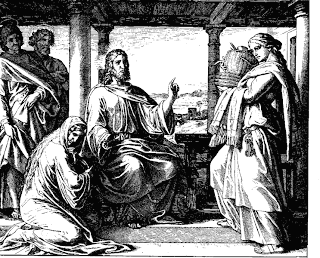
Now my answer is different. Jesus told the church to disciple the nations, and the church has always discipled the nations the same way Jesus discipled in his day. In the gospels, Jesus is always discipling with table fellowship. After his ascension, the table fellowship of Jesus turned into the table fellowship of the early church, which was a service of word and sacrament that eventually became what is now the historic church liturgy. So my answer now is this: We are theological to the extent to which we participate in the weekly liturgy. Our theology is shaped by the wisdom of the prayers that have been passed down for more than a thousand years, which we pray and sing each week.
While I enjoy discussing the faith intellectually, and am always reading through some theological book, I have come to think less of myself as a theologian and more of myself as a worshiper. I and my household will benefit most from sitting at the feet of Jesus in the liturgy and in devotions. As worshipers we learn to cry "Lord, have mercy," in times of need and our baptismal, Trinitarian faith is solidified.
On the other hand, if liturgy is theology and the law of prayer is really the law of belief, the liturgy must be grounded in the historic Christian faith. If not, it will produce bad theology so we must be Bereans. Liturgy is theology, and good theology must ground liturgy.
Reflection
Looking back, the analogies in the first part - comparing being a theologian to being a brewer, homeowner, etc. - feel somewhat strained. I now recognize they reflect the Lutheran idea of vocation, but also reveal a characteristically Protestant democratization of theology. While there’s truth in the domestic church concept, my “household theologian” framework lacked the proper understanding of how individual theological reflection must be ordered under the Church’s Magisterium.
As I reflect on this, I genuinely appreciate that the confessional denominations I was part of - Presbyterian and Lutheran - valued the liturgical tradition they inherited, even though it was more of a husk compared to the fullness of the Catholic Church’s tradition. I’m filled with gratitude that the Holy Spirit led me to see how faith is manifested through the tradition passed down in the liturgy as much as through Scripture. I appreciate that I was taught how the prayers in the liturgy, such as the Kyrie Eleison or the Sanctus (both present in the LCMS services), along with the Our Father, genuinely shape our thinking and living. While this can only be fully experienced in the Catholic Church, the understanding I gained within the LCMS was integral to my journey.
My focus on “table fellowship” in the post now stands out as revealing how much the Eucharist is diminished, even in denominations with high sacramental theology. While Lutherans affirm Real Presence through consubstantiation, this still represents a departure from the fullness of transubstantiation as understood by the Church Fathers. The Roman Canon, with its origins predating the formal canonization of the Bible, underscores the Eucharist as the sacrifice of Calvary made present, not merely a commemoration or fellowship meal. Without apostolic succession and communion with the Church, Protestant observances - however reverent - remain fundamentally different from the Catholic Mass. My earlier writing reflects a tradition that perhaps had a subconscious awareness of its own limitations.
What strikes me now is how my younger self’s emphasis on being a “worshiper” rather than “theologian” actually aligns with Catholic sensibility - lex orandi, lex credendi doesn’t eliminate theological study but properly orders it. However, I missed the important understanding that liturgy isn’t just something we “participate in” but is primarily the action of Christ through His Church. The Mass doesn’t merely preserve Tradition - it is the primary vehicle through which Tradition is transmitted and lived.
I remain profoundly grateful for how God guided me to understand that faith is communicated through liturgy and sacraments as much as through the Bible. These kernels of truth in the Lutheran Church serve as guideposts that can powerfully direct Protestants toward the fullness of Tradition.
Lastly, I’m critical of my statement about being “Bereans.” While perceptive for where I was, this reference implies that liturgy is subject to Scripture. In reality, Scripture is the fruit of Tradition, with the Mass at the heart of this living tradition. It’s not that the liturgy is biblical, but that the Bible is liturgical. As Catholics, we discern trustworthiness by holding teachings to both Scripture and Sacred Tradition, united under the teaching authority of the Church - not by individual interpretation, however well-intentioned.